

How To Choose The Right Pipe Wrenches In 2026
When a faucet adapter, water heater nipple, or stubborn threaded fitting refuses to move, the wrong pipe wrench can turn a routine repair into crushed pipe, damaged threads, or a fitting that has to be cut out. Choosing correctly comes down to pipe diameter, wrench capacity, access, jaw setup, and the material you are willing to mark.
Quick Answer
Choose a pipe wrench by the pipe's nominal diameter, the manufacturer's capacity marking, and the available working space—not by handle length alone. Use the shortest correctly rated wrench that lets you work square to the pipe; an 8-inch wrench suits roughly 1/4- to 3/4-inch pipe, while a 12-inch wrench covers roughly 1/2- to 1 1/4-inch pipe in the suggested ranges. Match the wrench configuration to the space, set the hook jaw leading in the turn with its shank clear, and switch to a strap or smooth-jaw wrench when teeth would damage the finish.
Table of Contents
- Quick Answer
- Our Top Picks
- Start With Pipe Size and Capacity
- Match the Wrench Configuration to the Access
- Set the Jaws Correctly Before Applying Force
- Protect Thin-Wall Pipe and Finished Fixtures
- Use the Wrench Wisely on Real Plumbing Repairs
- Frequently Asked Questions
- Conclusion
- Sources & References
Our Top Picks
Affiliate disclosure: if you buy through these links, we may earn a commission at no extra cost to you.


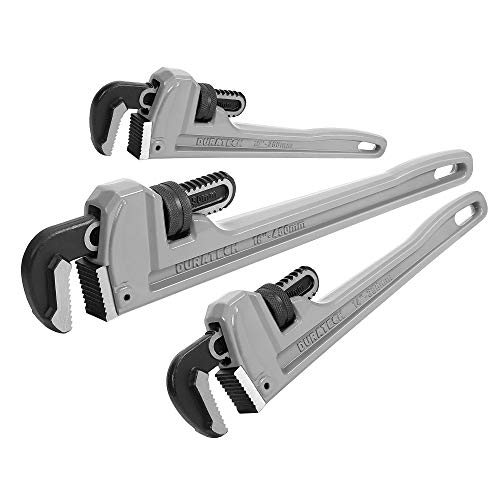
Start With Pipe Size and Capacity
The first mistake I see is choosing a wrench by how impressive the handle looks. Start with the nominal pipe diameter and the capacity stamped or listed by the manufacturer. The standard size chart covers nominal wrench lengths from 6 to 60 inches, with maximum listed pipe capacities ranging from about 3/4 inch to 8 inches. Those capacity markings are hard limits, not suggestions to ignore when a fitting is stubborn.
An 8-inch wrench is listed for a suggested 1/4- to 3/4-inch pipe range, with a 1-inch maximum. A 12-inch wrench is listed for a suggested 1/2- to 1 1/4-inch range, with a 2-inch maximum. For larger work, a 24-inch wrench is listed for approximately 1 1/2- to 2 1/2-inch pipe, with a 3-inch maximum, while a 36-inch wrench covers approximately 2 to 3 1/2 inches, with a 5-inch maximum.
Those ranges help you avoid both undersizing and overkill. A wrench that is too small may not seat correctly. A wrench that is much longer than necessary adds leverage and can crush, oval, or round softer fittings before the threaded joint gives up. In metric work, the common length bands are about 200 mm, 250-300 mm, 350-450 mm, and 600 mm, with typical capacities of roughly 25 mm, 38 mm, 50-65 mm, and 80 mm respectively.
Match the Wrench Configuration to the Access
Pipe wrenches are not all shaped the same because plumbing work rarely gives you a clear, straight pull. The six common configurations are heavy-duty straight, RapidGrip, end, offset, Raprench, and compound-leverage wrenches. The right choice is mainly an access and force decision: use a profile that lets the jaws seat properly and lets you keep the wrench square to the work.
A heavy-duty straight wrench is useful when you have a clear approach to exposed pipe and fittings. End and offset configurations help when a wall, neighboring pipe, valve body, or cabinet blocks a straight handle position. A Raprench or another compact profile can earn its keep where clearance is limited. A compound-leverage wrench is intended for heavy, stubborn threaded work, but its extra mechanical advantage does not cancel the manufacturer's capacity limits.
RapidGrip wrenches require their own attention. The workpiece should sit centered in the hook's V and make contact with both sides. If it is riding off-center, the wrench may not grip as intended, no matter how hard you pull. The same rule applies to every configuration: the wrench must fit the work, not merely reach it.
Set the Jaws Correctly Before Applying Force
A pipe wrench works through an angled, self-energising jaw arrangement. The hook jaw is movable, the heel jaw is fixed, and the teeth bite harder as turning force is applied. That action only works when the jaws are adjusted and oriented correctly. Open the wrench enough for the pipe to seat cleanly, then adjust it so the teeth engage without the tool rocking on the workpiece.
Pay close attention to the gap between the hook-jaw shank and the pipe or fitting. The shank should not be resting against the workpiece. If it makes contact, the gripping action is reduced, and the wrench can slip or damage the hook jaw. This is one of those small setup details that matters more than an extra hundred pounds of pulling force.
Keep the wrench square to the pipe rather than cocking it at an angle. The hook jaw should lead in the direction you are turning. If the wrench slips, stop immediately, release the load, reset the jaw, and check the angle. Do not solve a slipping wrench by pulling harder. That is how teeth get broken, fittings get rounded, and hands get caught when the tool suddenly lets go.
Protect Thin-Wall Pipe and Finished Fixtures
Pipe-wrench teeth are designed to dig into the workpiece. That is why they grip black iron and other hidden threaded pipe so well, but it is also why they can crush or oval thin-wall pipe, leave sharp edges, and cut into the surface finish. A toothed wrench mark may be acceptable on a concealed pipe fitting. It is not acceptable on every fixture in a finished bathroom.
Limit a pipe wrench to round pipe, threaded fittings, or soft round stock within the manufacturer's stated hardness limit. The guide sets a maximum material hardness of 325 BHN and warns against square, hexagonal, and other non-round stock. Do not grab a square valve stem, hexagonal part, or random piece of structural metal just because the jaws appear to fit.
Chrome-plated faucets, polished brass fittings, and shower heads deserve a different approach. On a finished faucet or shower head, use a strap wrench or smooth-jaw alternative when possible. The same caution applies to plastic components such as some sump pump discharge fittings and water filter housings. If the part cannot tolerate tooth marks or concentrated jaw pressure, a pipe wrench is the wrong first tool.
Use the Wrench Wisely on Real Plumbing Repairs
When replacing a faucet, use a pipe wrench only on a properly rated round threaded connection where tooth marks are acceptable. Do not grab the chrome faucet body or polished trim. On a water heater, a pipe wrench may be appropriate for a rated threaded pipe fitting, but keep the wrench square and use a counterhold where needed so you do not transfer unnecessary torque into an adjacent fitting or soft nipple.
Toilet repairs are another place where people reach for the wrong tool. Porcelain, supply-line nuts, and finished valve parts do not benefit from a toothed pipe wrench. A drain cleanout with a round threaded metal plug is a different matter, but a chemical drain cleaner is not a reason to attack a plastic trap or work blindly around a treated opening. Follow the drain-cleaner label and use the correct drain tool for the material and fitting.
The same judgment applies across the rest of the plumbing toolbox. Use appropriate smooth or supplied tools on plastic water filter housings and sump pump components. Use PEX cutters, crimpers, or expansion tools on PEX tubing; reserve the pipe wrench for a threaded transition fitting when it is correctly rated. A soldering kit makes a soldered copper joint, not a pipe wrench. If a wrench is needed on a threaded adapter during soldering work, use it before heating and never force a hot joint.
A cheap wrench with damaged teeth, a sloppy hook jaw, or an adjustment that will not hold is false economy on a seized fitting. A sound, correctly rated wrench in the right configuration earns its keep for years, but even the best tool cannot overcome the wrong material, a bad angle, or a jaw shank resting against the pipe.
Frequently Asked Questions
What size pipe wrench should I use for 3/4-inch pipe?
An 8-inch wrench is listed for a suggested 1/4- to 3/4-inch pipe range, with a 1-inch maximum. Confirm the capacity marking on your specific wrench and make sure you can keep it square to the pipe.
Is a bigger pipe wrench always better?
No. A longer wrench adds leverage, which can crush or round softer fittings and increase the damage if the tool slips. Use the shortest wrench that is correctly rated and gives you adequate access.
Why must there be a gap between the hook-jaw shank and the pipe?
The gap allows the jaws to develop their intended gripping action. If the shank contacts the workpiece, the wrench can lose grip, slip, or suffer hook-jaw damage.
Which way should the pipe-wrench hook jaw face?
The hook jaw should lead in the direction you are turning. Keep the wrench square to the pipe. With a RapidGrip wrench, center the workpiece in the hook's V so it contacts both sides.
Can I use a pipe wrench on chrome or polished brass?
You can, but the toothed jaws will likely mark the finish. Use a strap wrench or smooth-jaw alternative when working on chrome-plated fixtures, polished brass, faucets, or shower heads.
Can a pipe wrench be used on thin-wall, square, or hexagonal stock?
No. Pipe wrenches are intended for round pipe, threaded fittings, or suitable soft round stock within the stated hardness limit. Teeth can crush thin-wall material and are not intended for square, hexagonal, or other non-round stock.
Conclusion
The right pipe wrench is the one that matches the pipe diameter, stays within its capacity marking, fits the available access, and can be set square with the hook jaw leading and the shank clear. Before your next faucet, water heater, pipe-fitting, or drain repair, check the material and finish first, then choose a toothed, strap, smooth-jaw, PEX, or drain tool that suits the job. Set the jaws carefully, apply controlled force, and stop to reset whenever the wrench shifts—that habit prevents the pipe nightmare you were trying to avoid.


