

How To Choose The Right Pipe Wrenches For Tight
By Mike Hargrove
If you’ve ever tried to tighten a union nut on a water heater or disconnect a drain fitting under a double vanity, you know the struggle. Standard 14-inch pipe wrenches are great for open floor work, but in the cramped quarters of a utility closet or beneath a sink, they are nothing more than awkward metal bars that just spin uselessly. Choosing the right tool for tight spaces isn't about buying the most expensive brand; it's about understanding leverage geometry and jaw clearance so you can actually turn the pipe without stripping the threads or losing your knuckles.
Our Top Picks
Affiliate disclosure: if you buy through these links, we may earn a commission at no extra cost to you.

Table of Contents

Quick Answer
For tight spaces, swap your standard straight-handle wrench for a "striking wrench" (short handle) or a curved-handle basin wrench. The striking wrench offers maximum leverage in a short length, while the curved handle allows you to reach around obstacles like supply lines and P-traps. Always prioritize jaw clearance—the distance from the top of the handle to the pivot point—over overall length when working in confined areas.
The Geometry of Clearance
Most rookies make the mistake of bringing a 14-inch or 18-inch straight-handle wrench into a space that only has two inches of vertical clearance. It doesn't matter how strong you are; physics will win every time. In tight spaces, you aren't looking for length—you are looking for reach. You need to understand the "working envelope" of your tool. A long wrench requires a wide arc to turn a nut even a quarter-turn. If you have a cabinet door in the way or a wall right behind the pipe, that arc is impossible.
When I’m under a sink fighting a corroded compression fitting, I don't want to swing my arm; I want to push and pull with my fingers. This means selecting tools where the pivot point (the adjustment nut) sits as close to the jaws as possible. This reduces the overall profile of the tool, allowing you to slide it over existing pipes that would otherwise block a standard wrench.
Striking Wrenches: The Short & Powerful
The "striking wrench" (often called a short-handled or compact pipe wrench) is the first tool I grab when entering a cramped cabinet. These typically range from 8 to 10 inches in total length. Because the handle is so short, you can apply immense downward force without the handle hitting the floor or a cabinet bottom. They are designed to be struck with a hammer if necessary, which is why they are built like tanks.
The advantage here is leverage. A shorter wrench requires less physical strength to turn a stubborn pipe because you are applying force closer to the pivot point, but the jaw depth usually remains comparable to larger wrenches. This means you can still get a good bite on a 1-inch nipple even though the tool is tiny. Look for models with a "kick-back" guard or a textured grip; when you’re forcing a stuck valve in a tight spot, your hands will slip if the handle isn't secure.
Curved Handles for Obstacles
Sometimes, the problem isn't vertical clearance—it's horizontal obstacles. You might have plenty of room above and below a pipe, but a supply line runs directly across the path where your wrench handle needs to go. This is where curved-handle pipe wrenches shine. The handle bends away from the jaw, allowing you to grip the pipe while the handle clears the obstacle.
I use these frequently when working on shower valves or behind toilets where the tank is close to the wall. The curve allows the handle to rest against the wall or tank, giving you a fulcrum point to push against. Without that curve, your hand would be pinned between the wrench and the wall, making it impossible to apply torque. Ensure the curve matches the diameter of the pipes you work with most; a curve designed for 1/2-inch tubing won't help you if you're working on 1-1/2-inch drain lines.
The Basin Wrench Alternative
While not a traditional pipe wrench, the basin wrench is essential for faucet work in tight spaces. If you are dealing with the nuts holding a faucet to the deck of a sink or tub, a pipe wrench will just slip off the smooth nut or crush the plastic threads. A basin wrench has a long shaft with a pivoting jaw at the end that can rotate 180 degrees.
This tool is specifically engineered for the nightmare scenario: reaching down into the deep, narrow space behind a sink basin where your hand cannot fit. The pivot allows you to engage the nut from an angle and then turn it while the handle remains straight. For any job involving faucet installation or removal in a confined vanity, this is non-negotiable. Don't try to fake it with channel locks; you will strip the nut and regret it.
Jaw Clearance and Pivot Points
This is the technical detail that separates the pros from the DIYers who buy cheap tools at the big-box store. Look at the "throat depth" or jaw clearance of the wrench. This is the distance from the top of the lower jaw to the pivot pin. In tight spaces, you often have to slide the wrench over an existing pipe to get to a nut further down the line.
If your wrench has a deep throat (like a standard 14-inch wrench), it won't fit over a 1/2-inch supply line that is already in place. You need a "low-profile" or "compact" jaw design. Many modern compact wrenches are designed with a reduced throat depth specifically to slip over existing fittings. Always check the specs for "jaw clearance" if you are buying online, or physically test it in the store by sliding it over a pipe of similar diameter.
🛒 Relevant Products for This Topic
Affiliate disclosure: if you buy through these links, we may earn a commission at no extra cost to you.
KARRYTON Aluminum Pipe Wrench Set, 10" 14" 18" 24"(4 Pack) Adjustable...
$79.99
View Product Details →RIDGID 31100 Model 818 Aluminum Straight Pipe Wrench, 18-inch Plumbing Wrench
$79.99
View Product Details →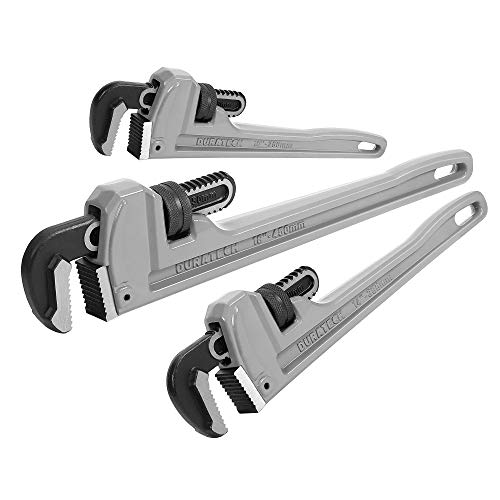
DURATECH 3-Piece Heavy Duty Aluminum Straight Pipe Wrench Set, 10", 14",...
$49.99
View Product Details →

